
SRINAGAR, JAMMU AND KASHMIR · WOOD AND LACQUER CRAFT · GI REGISTERED
Kashmir is the only part of India where the walnut tree grows in quantity at the altitude needed to produce dense, dark, tight-grained timber. The craft is therefore fixed to one geography in a way that very few Indian crafts genuinely are.
The craft
Carvers grade the tree before they grade the work. The root, doon kaend, is the darkest and most heavily figured, and is reserved for the finest pieces. The trunk gives a lighter, more even grain suited to larger panels and furniture.
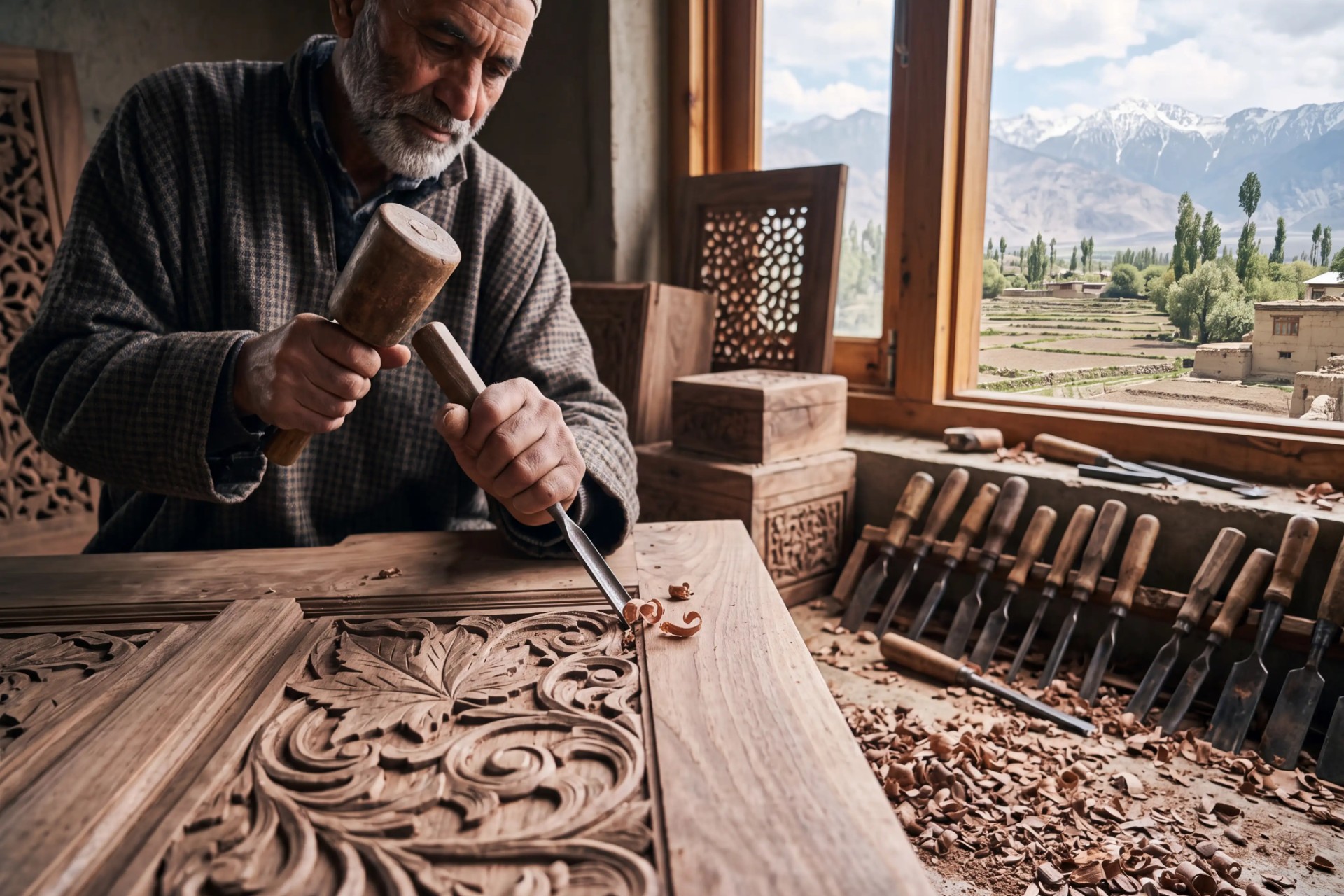
The design vocabulary is unmistakably Kashmiri: the chinar leaf, the lotus, running vine scrolls, and dense jali lattice cut clean through the panel. Work is graded by depth, from shallow semi-carving through undercut khokerdar to the deep openwork that can occupy a single carver for the better part of a year. Pieces are finished with oil and wax rather than stain, so the colour you see is the walnut’s own.
Provenance
Kashmir walnut wood carving is a registered Geographical Indication. Because mature walnut is now protected and very slow to replace, authentic pieces are scarce and increasingly imitated in cheaper timbers. We source only from registered Srinagar workshops and record the carver and the grade of wood for each commission.
The hands
In Srinagar’s carving workshops, the naqash works seasoned walnut — the only place in India the tree grows to carving girth — raising chinar leaves and lotus deep out of the grain. A single dense panel can hold months, sometimes a year, of one carver’s days.
What the craft is up against
A year-long panel needs a buyer willing to wait a year — and a carver able to eat while carving. Few markets offer either.
What your gift sustains
Advances against carving time are the difference between continuing and leaving the craft. Patient patronage, paid up front, is what a masterpiece actually runs on.
Gift this craft — every order is sourced fairly from this cluster.