
KANGRA, HIMACHAL PRADESH · PAINTING AND FOLK ART · HERITAGE CRAFT
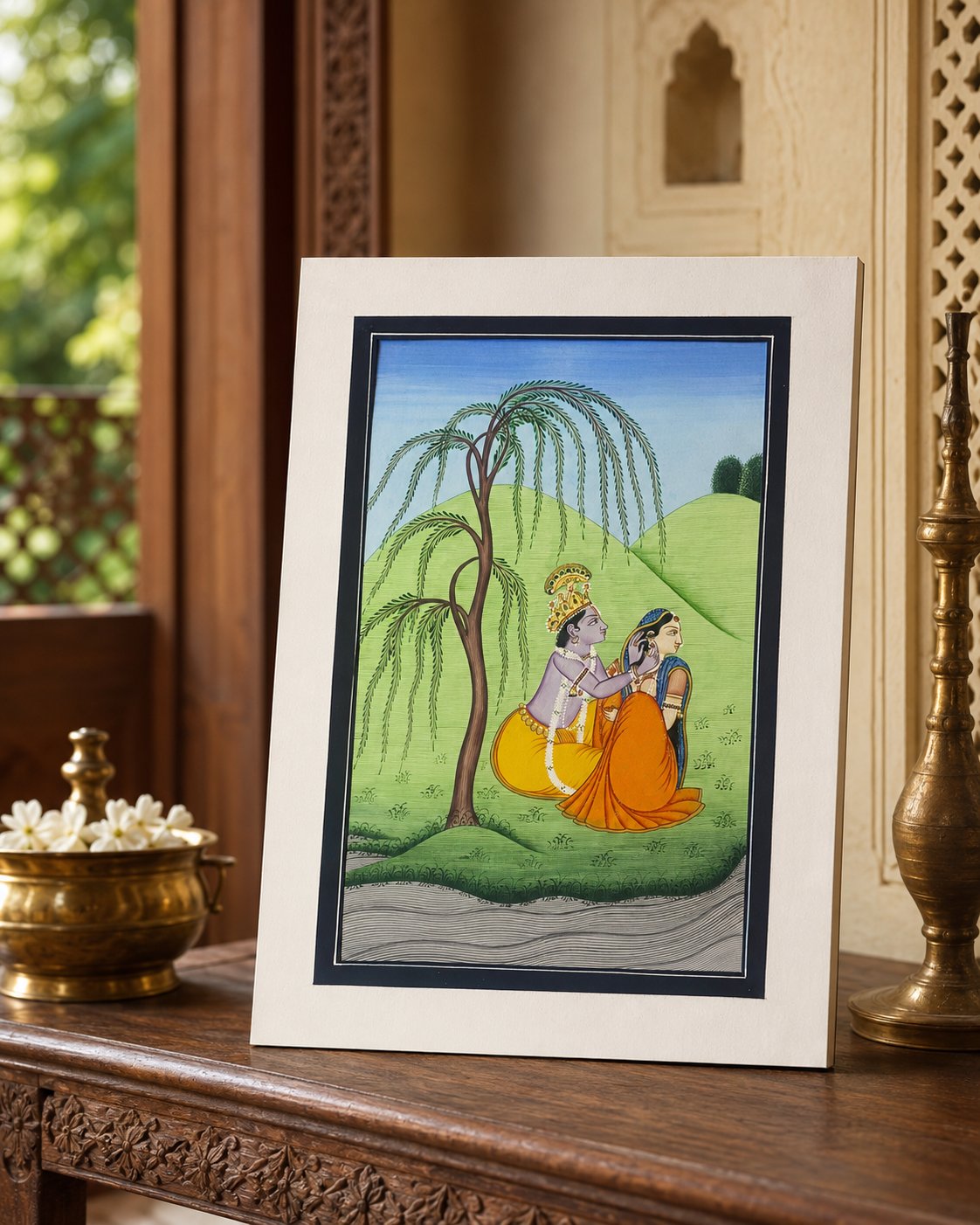
In the valley below Dharamsala a painter works at the scale of a hand — a willow, a green hillside, two figures seated beneath it — on paper burnished until it will take a line no thicker than a hair.
The craft
The ground is wasli: sheets of handmade paper pasted in layers and rubbed down with an agate burnisher until the surface is closed and faintly glazed. The drawing goes on first in thin outline, then colour — mineral and vegetable pigments ground by hand, indigo and malachite and vermilion and lamp-black, bound with gum and laid in washes thin enough that the paper still reads through them. The brushes are made in the workshop from squirrel-tail hair; the finest are reduced to a few hairs and kept for the eyes, the jewellery and the separate leaves of the willow. Between coats the sheet is turned over and burnished again. A single work of this size takes weeks, most of it spent on passages the eye reads in a second.
Provenance
Kangra painting carries a Geographical Indication, registered in 2012. The style came down from Guler, where painters trained in the Mughal idiom settled in the early eighteenth century; Nainsukh and his brother Manaku, sons of Pandit Seu, turned it towards something quieter and more closely observed. It reached its height in the late eighteenth century under Raja Sansar Chand, whose commissions ran to the Gita Govinda and the Bhagavata Purana — which is why so much of the surviving work is Radha and Krishna, and why the hills behind them are always this particular green.
The hands
Painters work in and around Kangra, Guler and Dharamsala, many descended from families that once held court commissions. When the princely states ended the patronage ended with them, and the skill survived in households rather than studios — passed down at home, with no institution behind it.
What the craft is up against
Very few painters still work the full method — hand-ground pigment, wasli, squirrel-hair brush. Printed reproductions sit beside the originals at a fraction of the price, and on a shelf they show the same picture. Weeks of work are asked to compete with an afternoon at a press.
What your gift sustains
Named commissions at fixed, fair rates pay for the weeks the method actually takes — and keep the Kangra Kalam a working trade in its own valley rather than a museum entry.
Gift this craft — every order is sourced fairly from this cluster.