
BASTAR, CHHATTISGARH · METAL CRAFT · GI REGISTERED
The people who pour this metal call themselves Ghadwa, from ghadna, to shape. They are the casting families of Bastar, concentrated around Kondagaon and Jagdalpur, and the lost-wax method they work every dry season is the same one behind the Harappan bronze dancing girl.
The craft
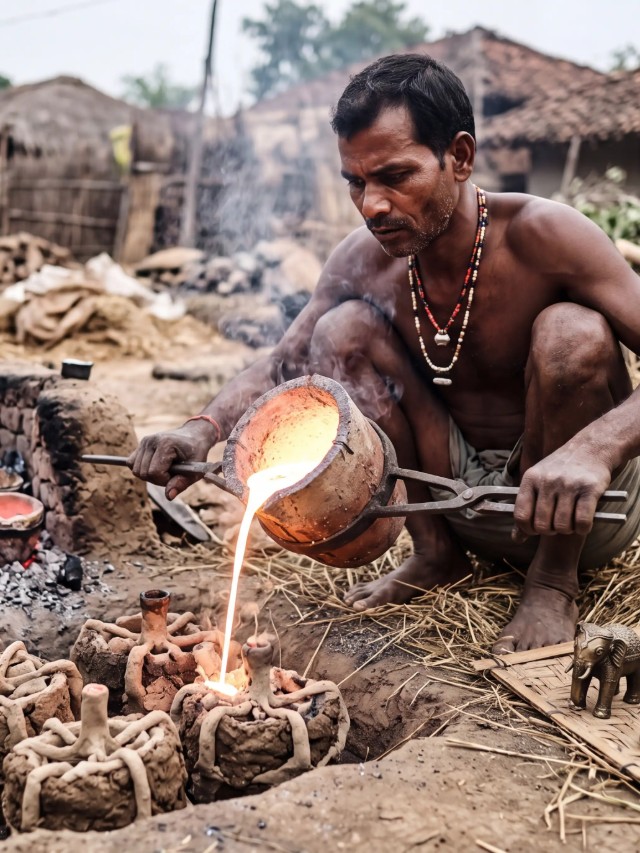
Dhokra is made by a household rather than a workshop. The figure is modelled first in clay, then wrapped in fine threads of beeswax rolled by hand — which is why a Dhokra surface reads as a coil of raised lines rather than as smooth metal. The wax is encased in clay, leaving a channel, and the whole mould is heated so the wax runs out. Molten brass goes in to take its place, and the mould is broken to release the casting, so every piece is unique by construction. The Ghadwa judge the pour by the colour of the metal rather than by any instrument: too red and the mould cracks, too white and the finest wax lines have not yet run clear. That judgement is learned standing beside someone who already has it, which is why the craft has never separated from the family that carries it.
Provenance
Bastar Dhokra carries a Geographical Indication. The work is seasonal by necessity — clay moulds will not hold in monsoon air, so casting finishes before the rains and the families turn to other work until the ground dries. What they make has shifted with the market: the household vessels that once paid for the year are barely asked for now, and the same hands turn out ghungroo bells, toe rings and nose pins alongside the Nandi bulls, elephants, tribal figures and lamps that carry the older vocabulary outward. The community has cast metal this way for a very long time, and the name Ghadwa still means, simply, the ones who shape.
The hands
The Ghadwa Adivasi households of Bastar build each figure twice: first in threads of wax wound over a clay core, then — after the mould is fired and the wax runs out — in molten bell-metal poured into the space the wax left behind. Whole families share the work, from kneading clay to breaking open the finished cast.
What the craft is up against
Bastar is far from every premium market. Scrap-metal prices swing, orders arrive seasonally if at all, and the distance lets intermediaries set the terms.
What your gift sustains
Fair advances pay for metal and wax before the fire is lit. Each cast figure represents days of a family’s labour — a direct order makes sure those days are paid at their worth.
Gift this craft — every order is sourced fairly from this cluster.