

AGRA, UTTAR PRADESH · STONE AND INLAY CRAFT · HERITAGE CRAFT
The inlayers of Agra live where they work — in the karkhanas of Taj Ganj, Gokulpura and Nai Ki Mandi, a few minutes’ walk from the building their trade is named for. Parchin kari is the Mughal art of setting cut semi-precious stone into hand-chiselled channels in white marble, and these lanes have kept the practice unbroken since the Taj Mahal’s inlays were commissioned.
The craft
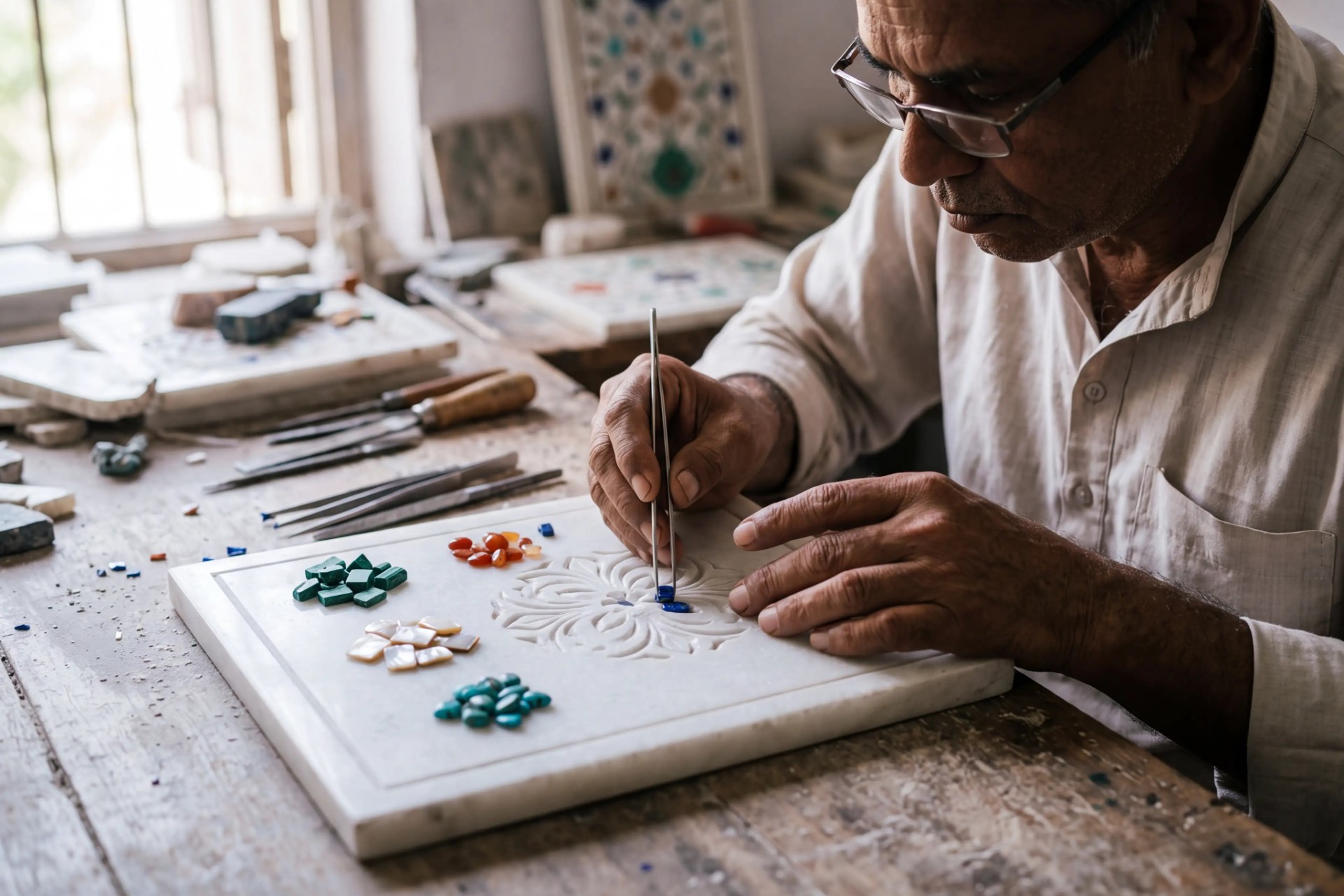
Each petal is a separate shard, and each stage of it belongs to a different pair of hands. Carnelian, malachite, lapis, jasper and mother-of-pearl are ground to shape on an emery wheel turned by a cane rod, then tried into a channel cut into Makrana marble with a hand chisel — the tankiya, the narzia — until the fit is airless. The stones are held with a lac cement warmed on a small brazier at the craftsman’s feet, and the whole surface is polished flat afterwards, so the finished flower can only be felt as colour rather than as relief. Cutting, setting and polishing are separate specialisms, and in these lanes they are shared across Hindu and Muslim families who have worked alongside one another for generations. A single bloom of thirty-odd pieces can take a week. The stones are graded by feel more than by eye.
Provenance
The Agra workshops descend directly from the ateliers assembled for the imperial building projects of the seventeenth century, and the vocabulary — the tulip, the iris, the vine border — comes from the same Mughal pattern books. The skill is inherited rather than taught: it passes down a family, from one generation at the wheel to the next sitting beside it, and the families are candid that it does not always repay the hours it asks for. It remains entirely a hand process. No two shards in a flower are cut to identical size, because no two spaces in the marble are.
The hands
Agra’s parchin kari families trace their skill to the workshops that inlaid the Taj Mahal itself. The work is unchanged: petals of cornelian, jasper and malachite ground to fit a marble bed so precisely that a fingertip cannot find the joint.
What the craft is up against
The tourist trade is flooded with soapstone imitations sold as marble inlay. Every fake teaches a buyer the wrong price — and takes a genuine family’s order with it.
What your gift sustains
Authenticated pietra dura at a fair price restores two things at once: the inlayer’s wage, and the pride of a lineage that built one of the world’s most loved monuments.
Gift this craft — every order is sourced fairly from this cluster.