
MADHUBANI, BIHAR · PAINTING AND FOLK ART · GI REGISTERED
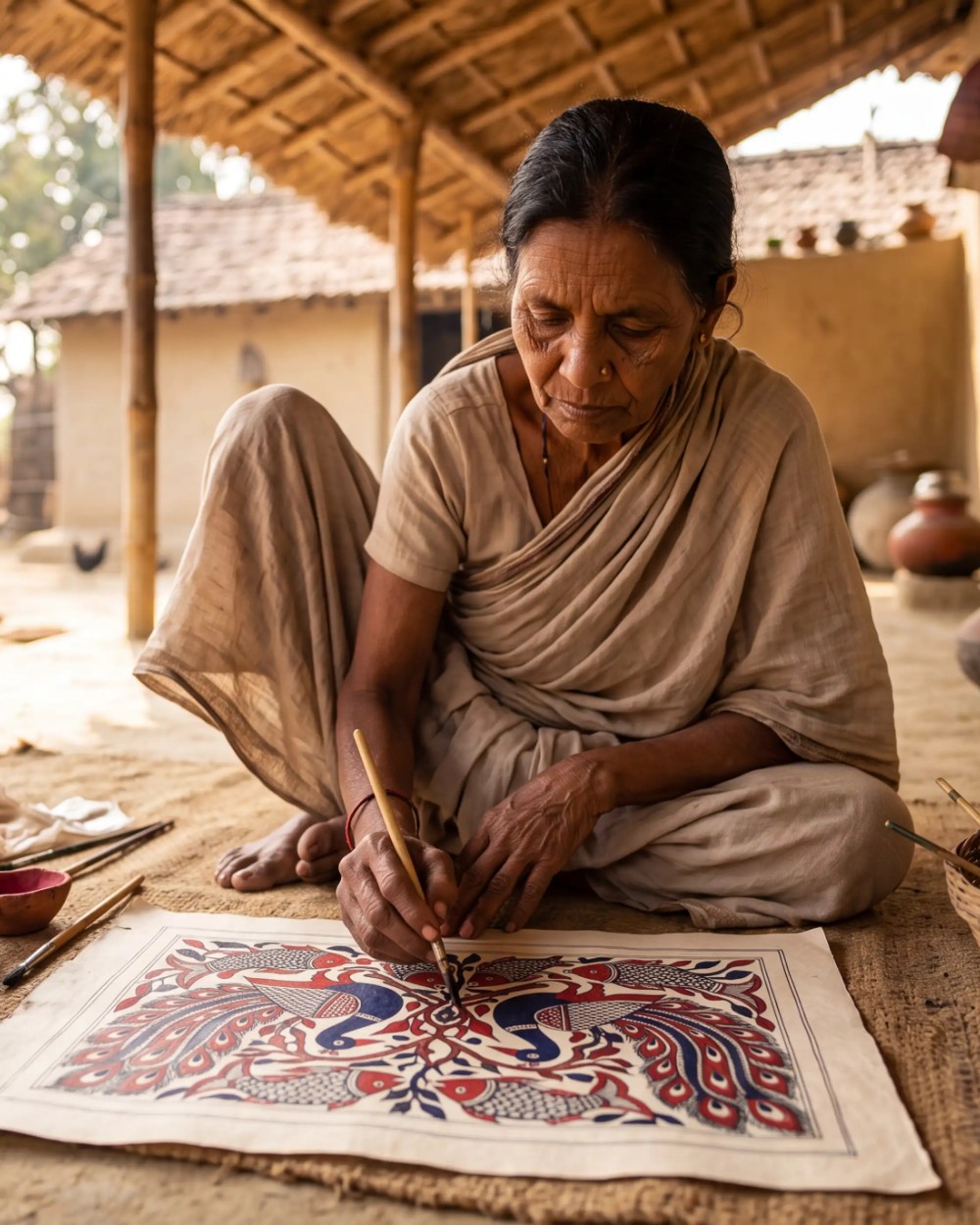
In the village of Jitwarpur, painting is taught the way language is — line by line, day by day, from grandmother to granddaughter. The kohbar, the marriage chamber painting, is where a Mithila artist learns her hand.
The craft
Kohbar is a wedding image before it is anything else: the lotus pond, the bamboo grove, the sun and moon, and the interlocked forms that stand for the union itself. Two styles carry it. Kachni is line alone — fine parallel hatching, no fill, drawn with a bamboo nib. Bharni fills the enclosed shapes with flat colour and outlines them in black. Traditionally the pigments were domestic: soot for black, turmeric for yellow, bilva leaf for green, the red of kusum flower. Nothing is sketched first. The composition is held in the head and committed straight to the surface.
Provenance
Madhubani painting carries a Geographical Indication covering the Mithila region of Bihar. It moved from mud wall to paper only in the 1960s, when drought relief work encouraged women painters to sell their work — which is how a domestic ritual practice became one of India’s most recognised folk art traditions while remaining, in the villages, largely a craft of women.
The hands
Jitwarpur is a village of painters, and its classrooms are kitchens and courtyards: grandmothers teaching granddaughters the kohbar’s dense, sacred line. Some households hold national awards. Few hold incomes to match.
What the craft is up against
Fame without fair price. Madhubani is copied everywhere — on prints, packaging and machine textiles — while the source households negotiate from weakness.
What your gift sustains
A fair order changes what the art is in a family’s ledger: a daughter’s inheritance becomes a daughter’s livelihood, not just a memory of her grandmother’s hand.
Gift this craft — every order is sourced fairly from this cluster.